What is osteoarthritis?
Osteoarthritis, also called degenerative joint disease, is the most common joint condition.
It is a degenerative disease that primarily affects articular cartilage, the structure covering joint surfaces that allows smooth, low-friction movement.
Approximately 99% of cases are primary osteoarthritis. This means there is a genetic predisposition to develop it. The person did not necessarily do anything wrong; it is often part of their inheritance.
Secondary osteoarthritis is much less common. It can result from major trauma, anatomical abnormalities, metabolic diseases or other conditions that previously damaged the joint.
Where does it occur most often?
Osteoarthritis does not affect every joint with the same frequency.
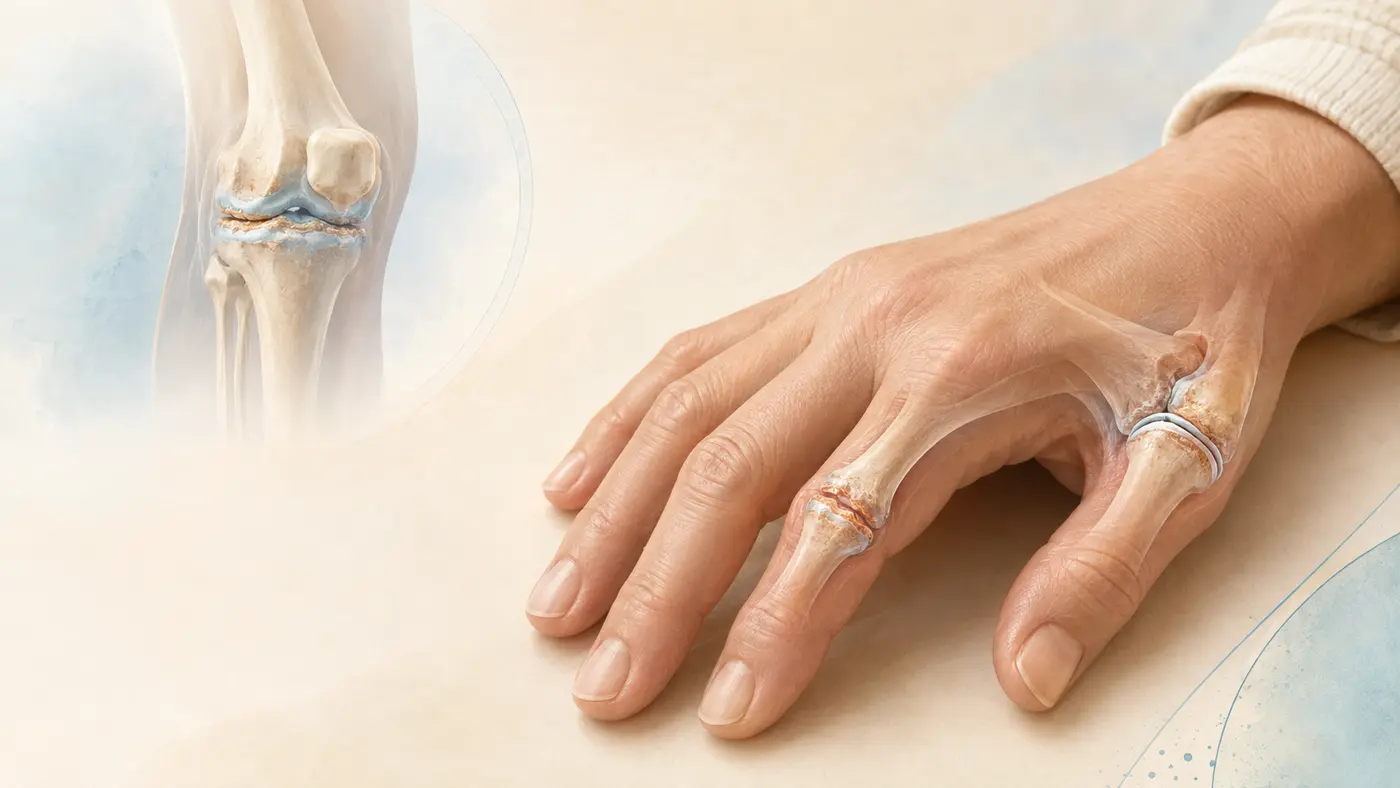
In the hands, it commonly affects the interphalangeal joints and may produce visible finger nodes. It also often affects the base of the thumb, where it is known as thumb-base osteoarthritis.
It is also common in the spine, knees and feet.
Hip osteoarthritis exists, but in my experience it is considerably less common than osteoarthritis of the hands, knees or spine.
Common symptoms
Osteoarthritis may cause pain, short-lived stiffness, restricted movement and progressive deformity.
Nodes and visible joint changes may appear in the hands. The knees may occasionally develop a joint effusion. In the spine, it may cause neck or low-back pain.
Pain intensity does not always match what an X-ray shows. Some people have substantial radiographic changes with few symptoms, while others experience significant pain with less striking abnormalities.
If cartilage has no nerves, why does it hurt?
Articular cartilage has neither nerves nor blood vessels. Cartilage itself therefore cannot feel pain.
An important part of the pain comes from subchondral bone, the bone immediately beneath the cartilage.
The fluid inside the joint also changes and may contain mediators that promote pain. This is why some treatments can reduce symptoms without rebuilding cartilage.
Can cartilage degeneration be stopped or reversed?
At present, no treatment has been shown to stop the degenerative process completely or regenerate lost cartilage.
There is also no cartilage transplant that broadly resolves osteoarthritis. Research continues, but something that has not been proven should not be presented as a cure.
So-called stem-cell therapies have likewise not been shown to regenerate cartilage or cure osteoarthritis. Offering them as guaranteed reconstruction creates expectations that current evidence cannot support.
Weather and the moon
Many people feel that their pain changes with cold, rain or certain phases of the moon.
However, there is no solid scientific evidence that weather or the moon causes osteoarthritis or determines its progression.
A person may perceive real changes in symptoms, but that individual experience does not prove that the weather is destroying the joint.
Collagen and gelatin do not regenerate cartilage
The collagen and gelatin we consume are digested like any other protein.
They do not travel intact to a knee, hand or hip, and they do not rebuild lost cartilage.
Presenting them as a form of joint regeneration is not consistent with current knowledge.
Hyaluronic acid may relieve pain, but it does not regenerate cartilage
Hyaluronic acid injections may relieve pain in some patients.
Their effect is not to create new cartilage or merely lubricate the joint as though it were a hinge needing oil.
Hyaluronic acid may block or modify pain mediators within the joint.
It is usually more useful in early or moderate stages, while some cartilage remains. In severe osteoarthritis with advanced destruction, the chance of benefit is lower.
Treatment must be adapted to each person
There is no single treatment for everyone with osteoarthritis.
Management depends on the affected joint, pain intensity, degree of limitation, muscle strength, weight, age, other conditions and stage of joint damage.
It may include education, adapted exercise, muscle strengthening, weight reduction when appropriate, physical therapy, carefully selected medicines, local measures, injections and, at advanced stages, surgical assessment.
The realistic goal is to reduce pain, preserve function and allow the person to remain active. We should also avoid unnecessary treatments and promises of regeneration that cannot be fulfilled.