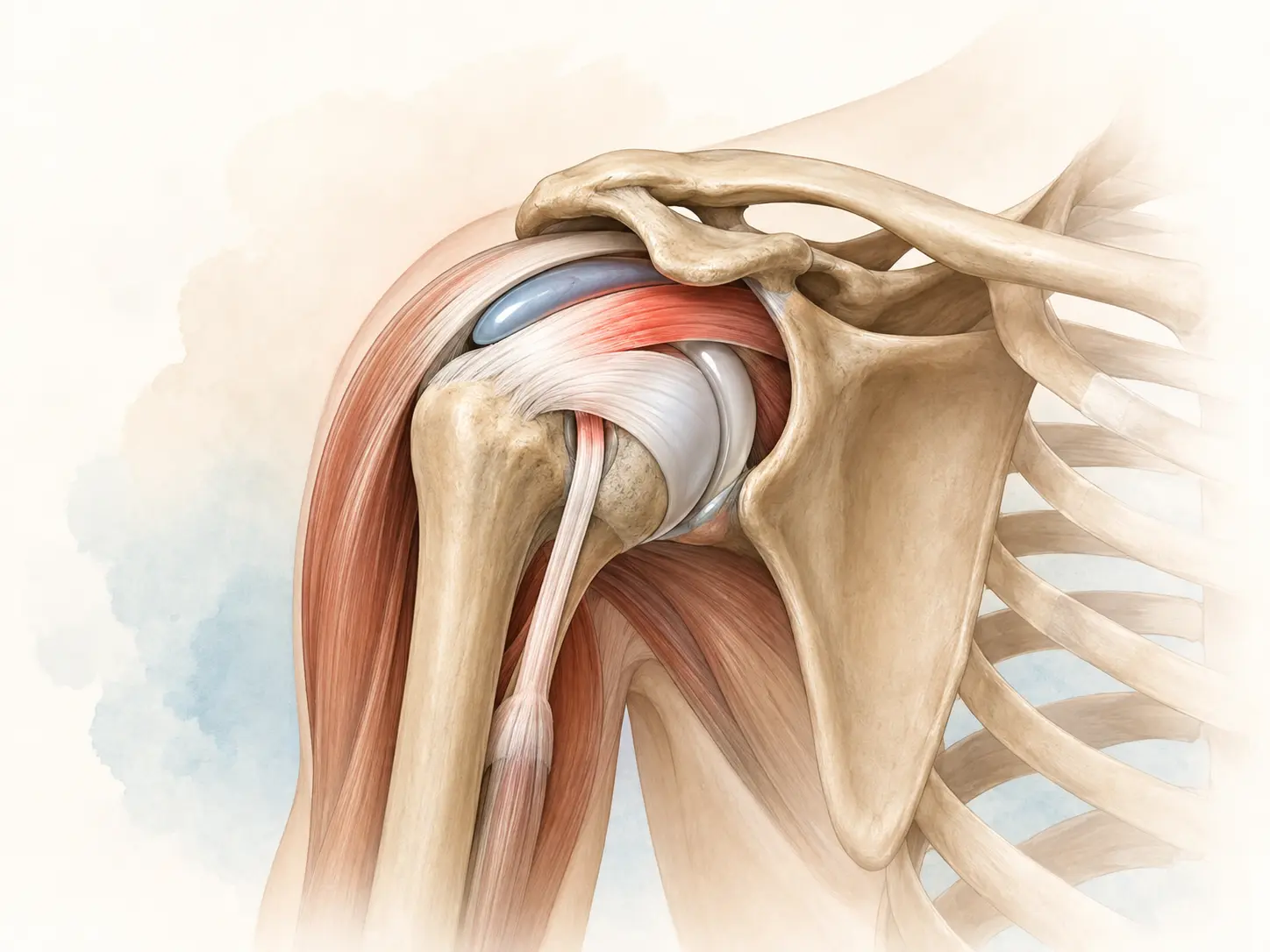
Shoulder pain: causes, diagnosis and treatment
Shoulder pain, also known as omalgia or painful shoulder syndrome, is an extremely common reason for consultation.
It can appear in younger people because of physical exertion, sports or lifting heavy objects. It is also common in older adults, when tendons weaken and may be injured or even tear spontaneously.
Does the pain always originate in the shoulder?
Pain can radiate to the shoulder from another structure, although this is uncommon.
The medical history usually establishes when an injury occurred and how the pain began. Physical examination helps confirm whether the source is actually the shoulder.
When the patient is heard and properly examined, it is generally quite difficult to mistake the origin of the pain.
The shoulder does not work in isolation
To understand shoulder disorders, it is important to remember that the shoulder joint forms part of an entire movement girdle.
This girdle surrounds the upper body and includes:
- The chest and ribs.
- The sternum.
- The clavicles.
- The acromioclavicular joints.
- The shoulder blades.
- The scapulothoracic articulations.
- The spine.
All these structures work together during movement of the shoulder and arm. The shoulder should therefore not be assessed as an isolated joint.
The rotator cuff
Shoulder movement depends greatly on the rotator cuff, formed by four tendons that join like a belt and insert around the joint.
One of the sites where these tendons attach is also one of the most frequent sources of pain.
The tendon that is almost always involved is the supraspinatus. It is essential for movement and carries a substantial part of the shoulder's load.
The biceps tendon may also be affected, although less often. After age 70, spontaneous tears can occur, particularly because of progressive tendon weakening and areas with critical blood supply.
Shoulder bursitis
When injury to the supraspinatus and other tendons is significant, the subacromial-subdeltoid bursa, considered the largest bursa in the human body, may become inflamed.
The bursa helps tissues glide. When inflammation enlarges it, impingement can occur and raising the arm may become very difficult.
The patient may have severe pain and be unable to raise the arm adequately, particularly above approximately 110 degrees.
Severe pain without visible swelling
Shoulder conditions may cause very severe pain and substantial loss of movement, yet true swelling is almost never seen during examination.
This is because most of these injuries are extra-articular: they are mainly in the rotator-cuff tendons and, less often, the biceps tendon.
A patient may have a great deal of pain without the shoulder looking externally inflamed.
Frozen shoulder
In some cases, a frozen shoulder develops and the joint loses nearly all its mobility.
The person may struggle to lift the arm, get dressed, comb their hair or perform daily activities. Limitation can be profound even without visible swelling.
When fluid or true swelling is present
Finding fluid or true swelling in the shoulder is uncommon and very concerning.
Few diseases can cause it. When present, the cause should be investigated promptly through examination, an X-ray and, when necessary, aspiration of the shoulder.
If aspiration produces bloody fluid, a destructive lesion or shoulder necrosis should be considered, especially later in life.
There are also rare, highly destructive inflammatory diseases caused by crystals, such as Milwaukee shoulder.
These conditions are exceptional, but they show why a truly swollen shoulder should not be assessed like an ordinary tendon injury.
History and examination guide the choice of studies
The medical history and physical examination help determine which structure may be affected and which studies are truly necessary.
Not everyone with shoulder pain needs the same tests. First, it is necessary to establish:
- How the pain began.
- Whether there was prior trauma or exertion.
- Which movements are limited.
- Whether the problem seems to arise from the tendons, bursa or joint.
- Whether unusual findings such as fluid or swelling are present.
Only after this assessment should the study most likely to provide useful information be selected.
Surgery is almost never necessary
Surgery is rarely necessary for painful shoulder syndrome.
With a sound clinical approach, only the studies that are truly needed and well-directed physical therapy, most people can relieve pain and recover adequate function.
Even when one tendon is completely torn, appropriate exercises and time may allow the pain to disappear.
Some functional limitation may remain, particularly when raising the arm above 110 degrees, but this does not necessarily mean that pain will continue.
Each patient requires a different approach
Shoulder pain is not a single diagnosis. It may be caused by injuries to different tendons, bursal inflammation, progressive loss of movement or, in exceptional cases, destructive joint disease.
Each patient must therefore be approached individually.
The essentials are to hear how the problem began, correctly examine the entire shoulder movement girdle and request only the studies appropriate to the clinical suspicion.
It is a very common condition, but with correct diagnosis and therapy it can almost always be resolved satisfactorily without an operation.